

Red Badge Courage 1973 Facsimile Manuscript #92
$211.00
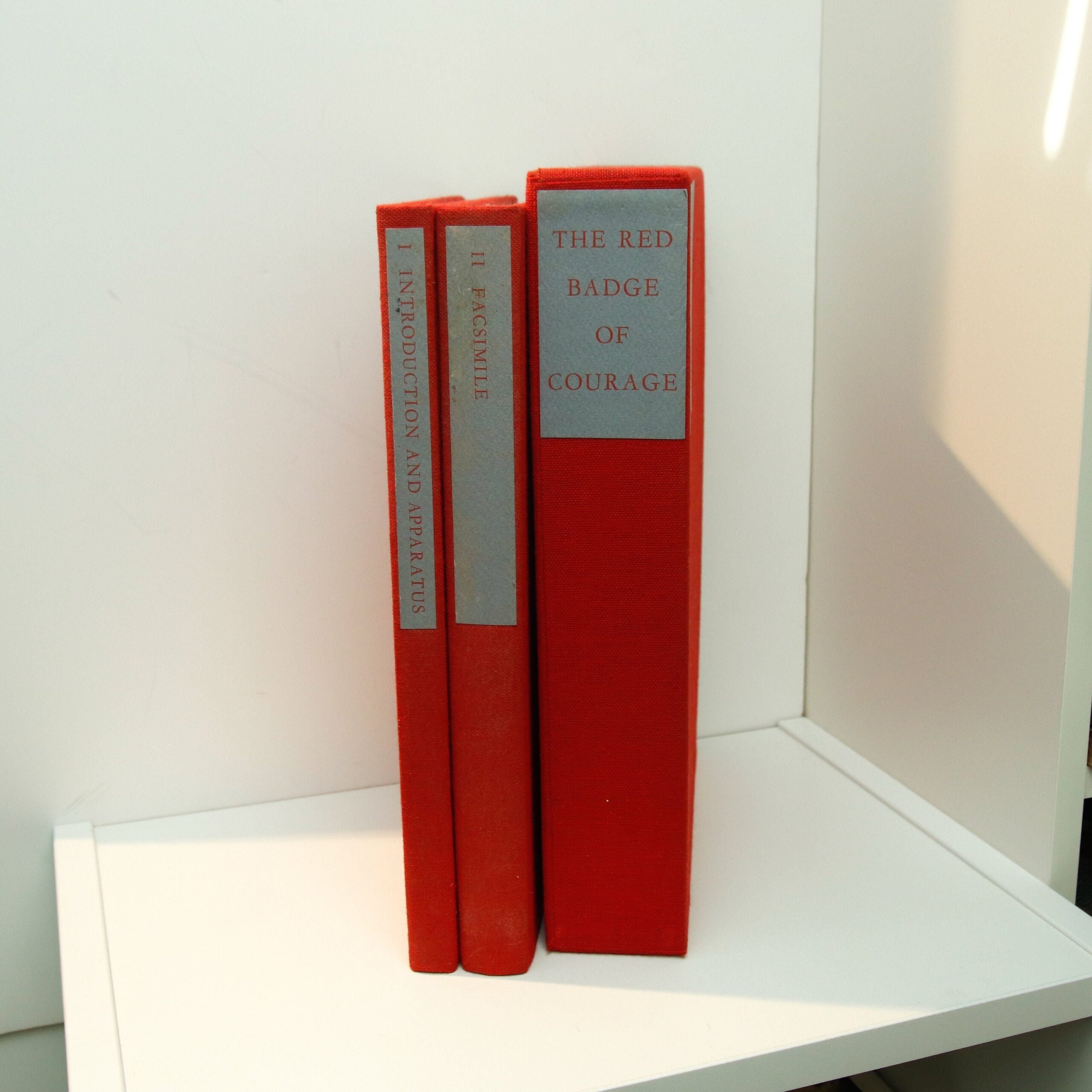
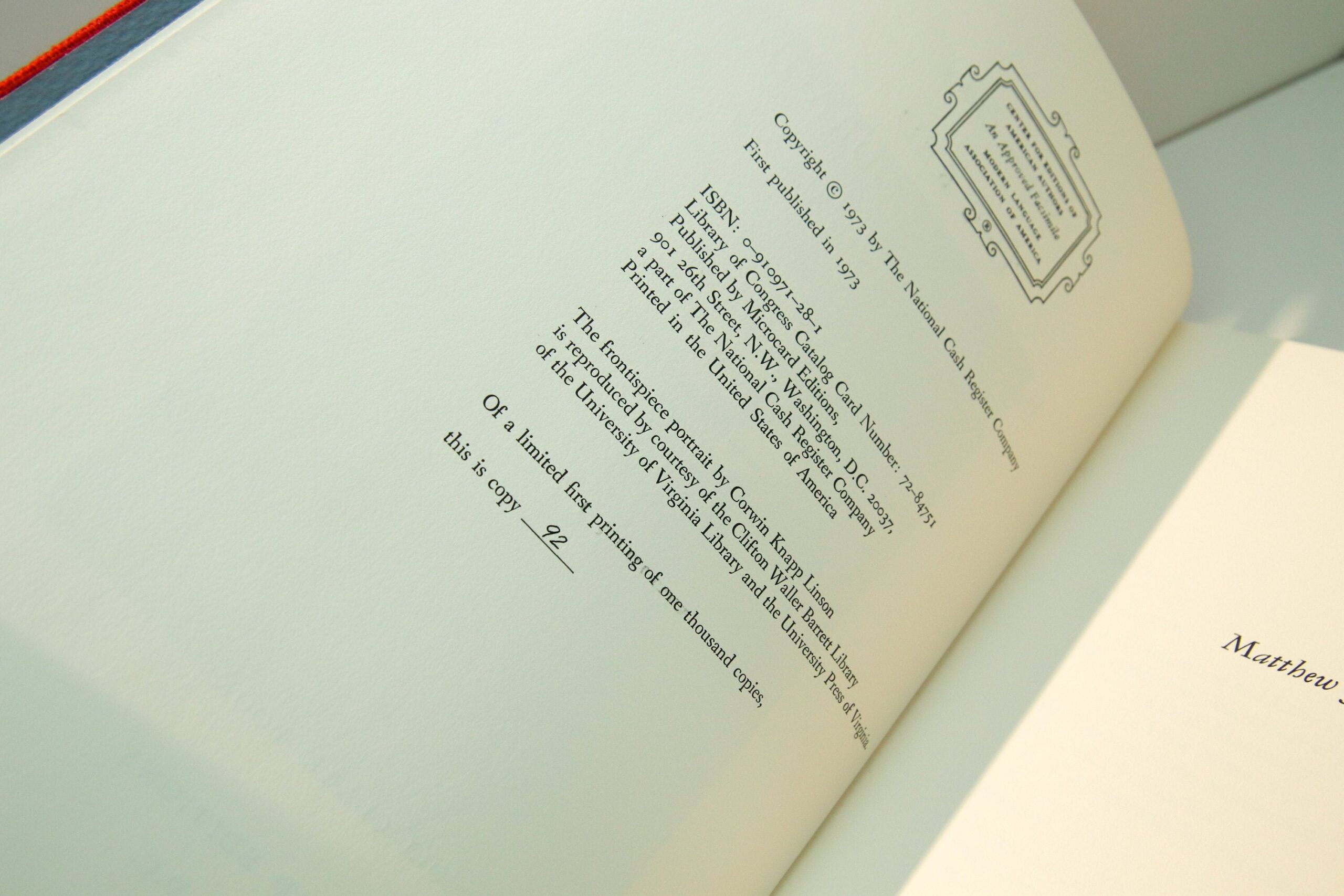
📚 The Red Badge of Courage: A Facsimile Edition of the Manuscript by Stephen Crane (1871–1900), edited with introduction and apparatus by Fredson Bowers. Published 1973 by Microcard Editions (National Cash Register Company), Washington, D.C. Copy #92 of a limited first printing of 1,000 copies, approved by the Center for Editions of American Authors / Modern Language Association of America.
QUICK FACTS
- Author: Stephen Crane (1871–1900)
- Editor: Fredson Bowers (1905–1991), University Professor of Bibliographical Studies, University of Virginia
- Publisher: Microcard Editions (NCR), Washington, D.C.
- Year: 1973 (first edition facsimile)
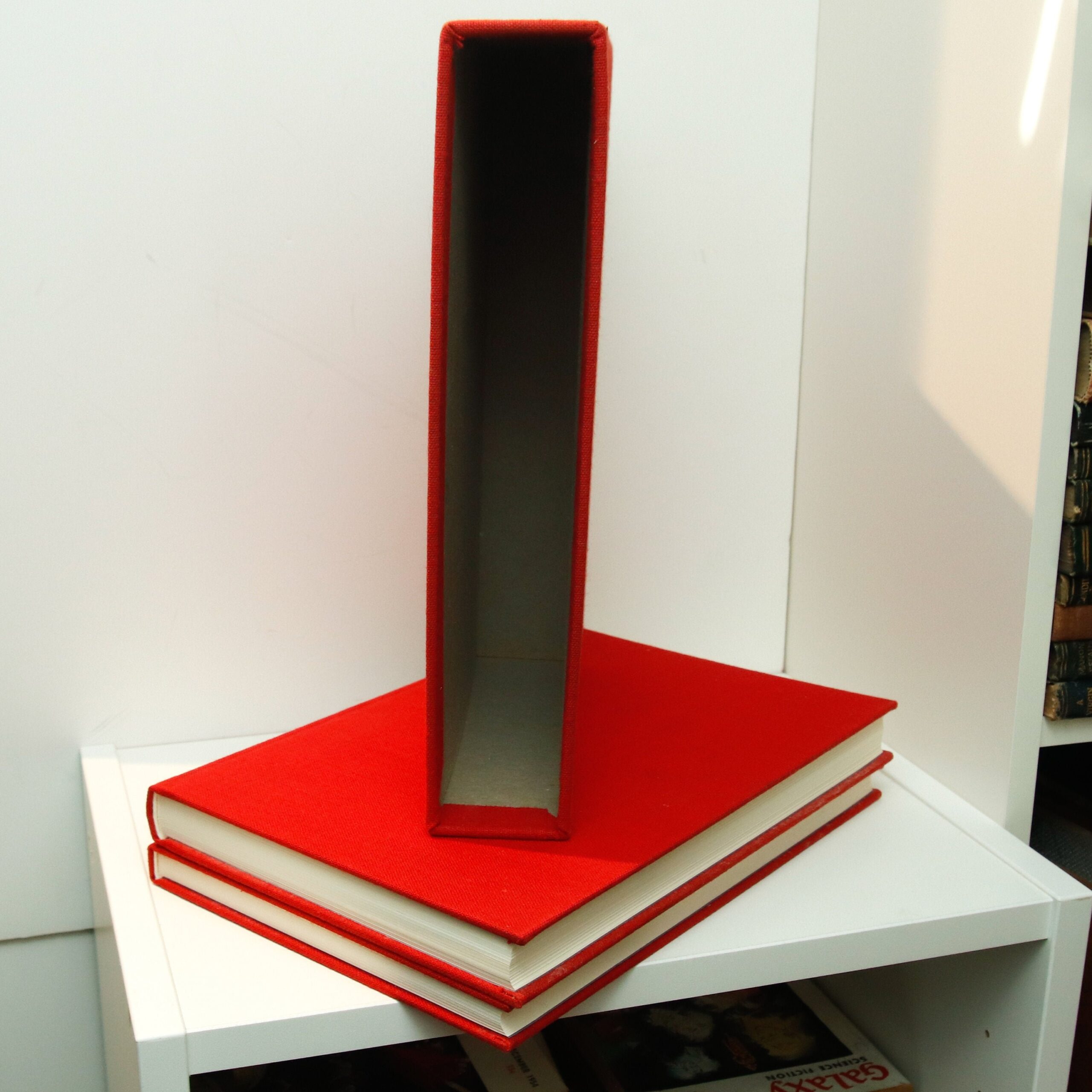
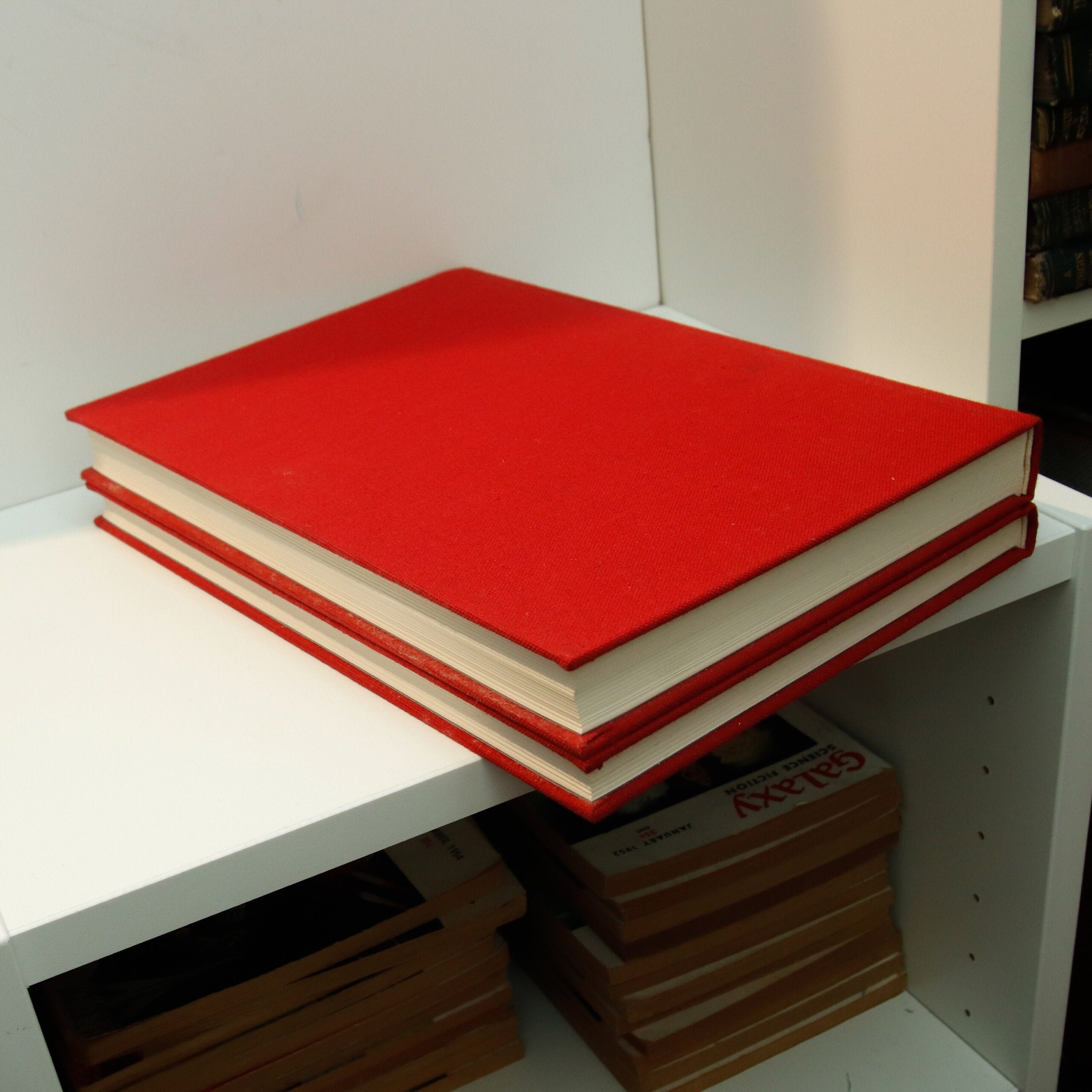
- Format: Two volumes in buckram-wrapped slipcase
- Pages: Vol. I: 121 pp. (Introduction & Apparatus) | Vol. II: 263 pp. (Manuscript Facsimile)
- ISBN: 0-910971-28-1 | LC: 72-84751
- Condition: Near mint, possibly unread. Full report below.
THE STORY
Stephen Crane wrote The Red Badge of Courage in 1894–1895, drawing not on personal military experience but on Civil War accounts he read in Century Magazine while sharing a studio with painter Corwin Knapp Linson in New York. Crane reportedly declared: “These fellows spout eternally of what they did, but they never say how they feel. They are as emotionless as rocks.” The resulting novel, published in 1895, redefined war fiction by focusing on the interior psychological experience of combat rather than strategic narrative. Crane died of tuberculosis at age 28, having produced one of the most influential novels in American literature.
THIS EDITION
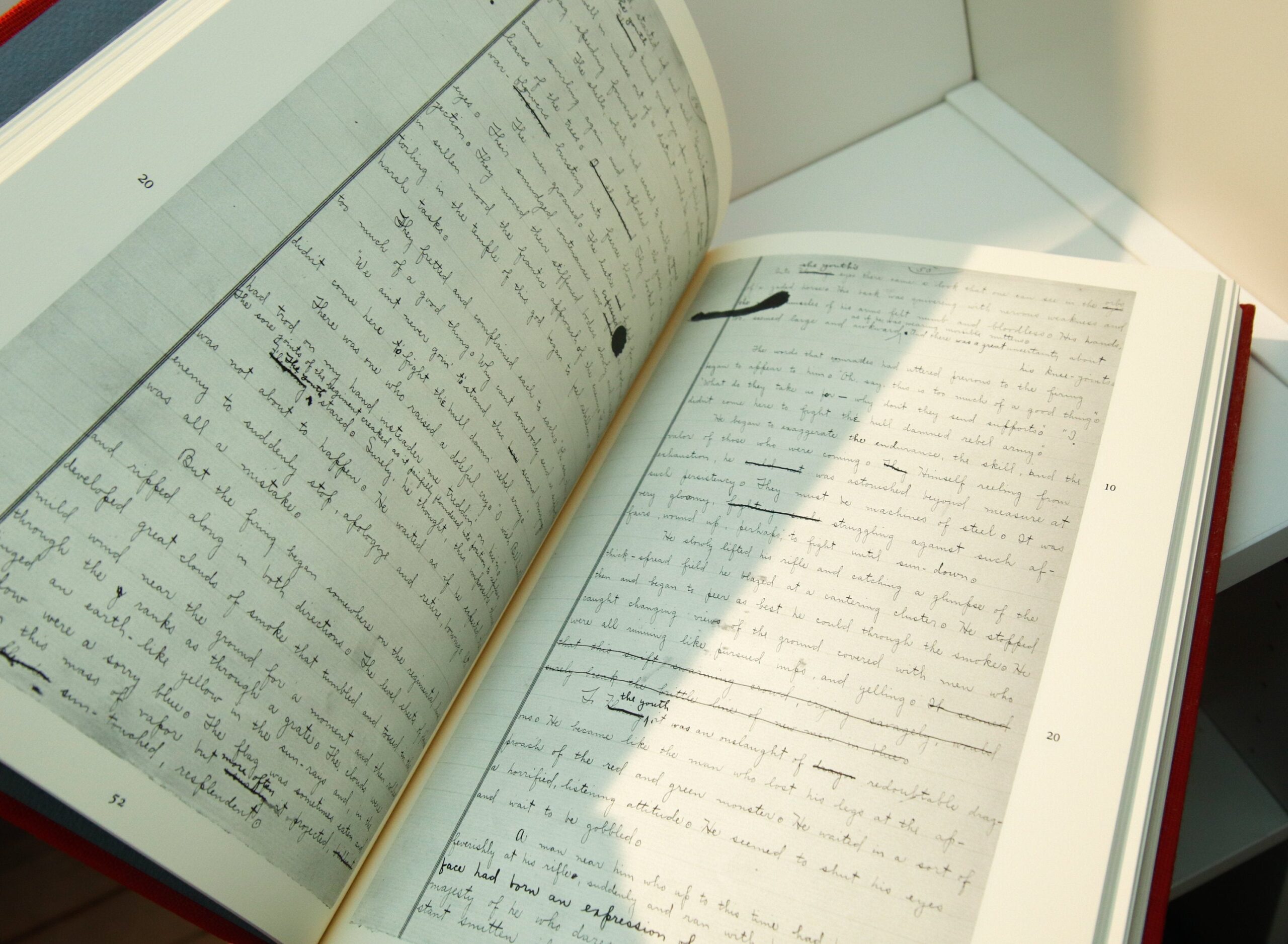
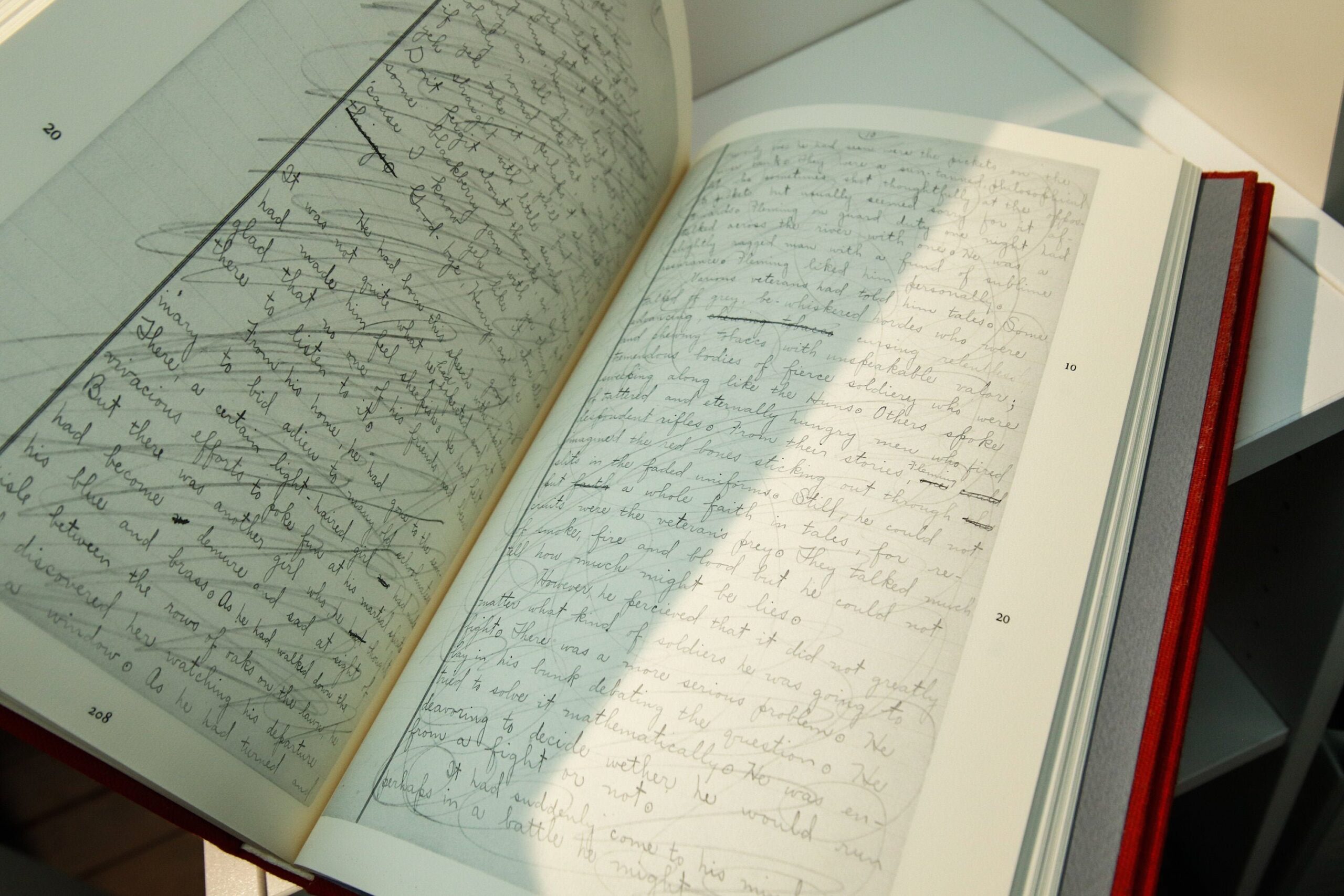
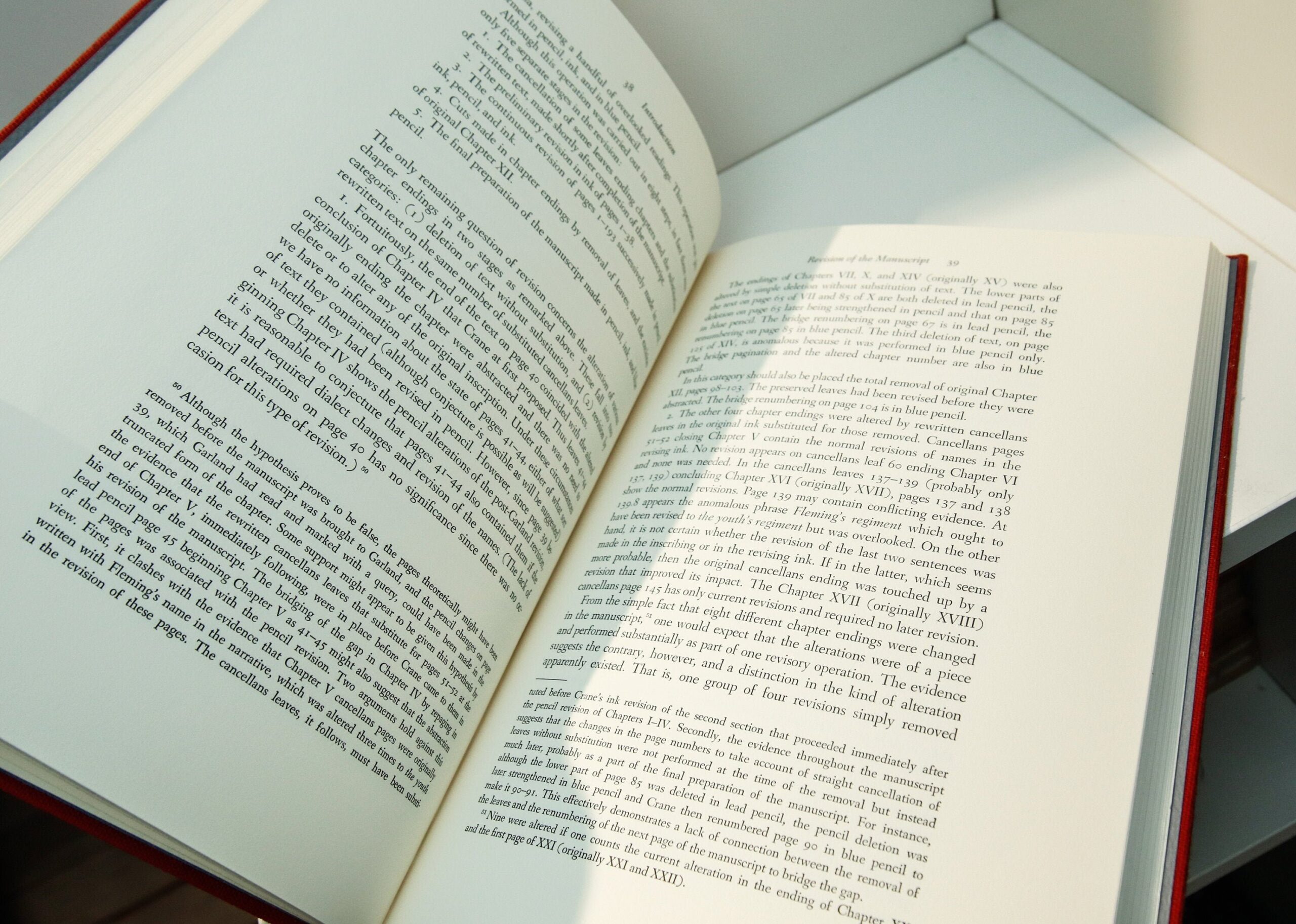
This 1973 facsimile edition reproduces Crane’s original handwritten manuscript from the Clifton Waller Barrett Library at the University of Virginia. Volume I contains Fredson Bowers’s scholarly introduction and apparatus, analyzing five distinct stages of Crane’s revision process: cancellation of leaves, preliminary ink revision, continuous revision, cuts to chapter endings, and final preparation. Volume II is a page-for-page reproduction of Crane’s handwritten draft, complete with his crossings-out, marginal notes, ink revisions, and pencil annotations. The manuscript reveals Crane’s compositional method: heavy revision in lead pencil, blue pencil, and revising ink across multiple chapters. The Center for Editions of American Authors (MLA) approved this as the authoritative scholarly facsimile.
THE MANUSCRIPT
The facsimile pages show Crane’s cursive handwriting in dark ink on cream paper, with extensive revisions throughout. Passages are crossed out with thick black lines, words are substituted, and entire paragraphs are reworked. The visible editing process is the primary scholarly value of this edition — readers can trace how Crane shaped raw narrative into the tightly controlled prose of the published novel. The frontispiece is a color portrait of Crane by Corwin Knapp Linson (1864–1959), Crane’s friend and studio-mate, reproduced by courtesy of the Barrett Library at the University of Virginia.
WHY IT MATTERS
- Fredson Bowers was the most influential textual scholar of 20th-century American literature; his editorial work on this edition is the definitive study of Crane’s compositional process
- The Center for Editions of American Authors (CEAA) seal of approval makes this the MLA-sanctioned scholarly facsimile — the version cited in academic research
- Crane’s original manuscript is held at the Clifton Waller Barrett Library, University of Virginia; only 1,000 numbered copies of this facsimile were produced
- Corwin Knapp Linson (1864–1959) was the painter who inspired Crane to write the novel; his portrait of Crane is the standard likeness used in scholarly works
FREQUENTLY ASKED
What edition is this? First edition facsimile of the manuscript, published 1973 by Microcard Editions (NCR), edited by Fredson Bowers. Copy #92 of 1,000.
What condition is it in? Near mint, possibly unread. Full report below.
Is this the complete manuscript? Yes. Volume II contains a page-for-page facsimile of Crane’s handwritten draft as held at the University of Virginia’s Barrett Library.
FOR COLLECTORS
Low-numbered copies (#92 of 1,000) in near-mint condition with intact slipcase are uncommon. The Bowers apparatus alone is a significant work of textual scholarship, and the manuscript facsimile provides primary-source access to one of American literature’s most studied compositional processes. The CEAA approval seal and Linson frontispiece add provenance value for collectors of Crane, Civil War literature, and American first-edition scholarship.
This is a two-volume set, in slipcase, both books “near mint” with no significant signs of wear, may be unread, published in 1973 by the National Cash Register Company.
Limited, 1000 issued, number, first-edition thus, #92 of 1000.
Volume 1 is 121 pages, containing Introduction about draft manuscripts and the final, plus Apparatus.
Volume 2 is 263 pages, containing the scans of Mr. Crane’s original manuscript.
Volume 2 has what might be a very faint circular discoloration near the spine, about nickel size.
The slipcase is also buckrum wrapped, solid all around. Some light shelving wear to the cloth on the bottom edge.
Really pleasing set!
Will ship promptly, carefully packaged.
HFB-SEO-v1: 2026-07-05
1 in stock
Related products
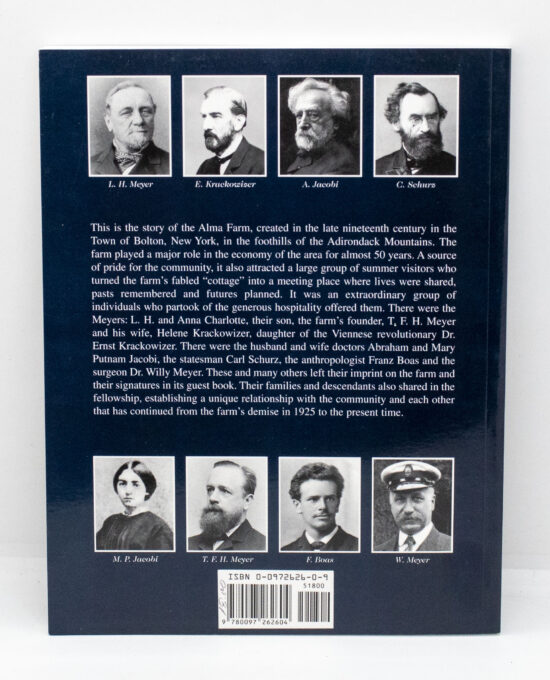
Alma Farm Adirondack Meeting Place 1999 First Ed
Alma Farm Adirondack Meeting Place 1999 First Ed
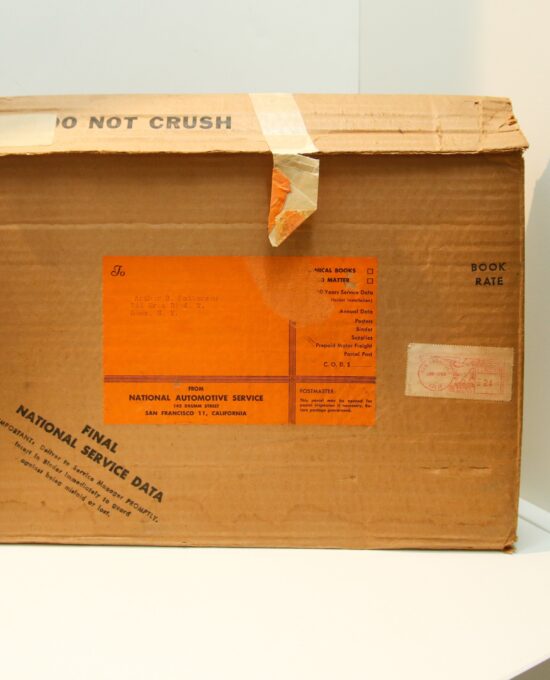
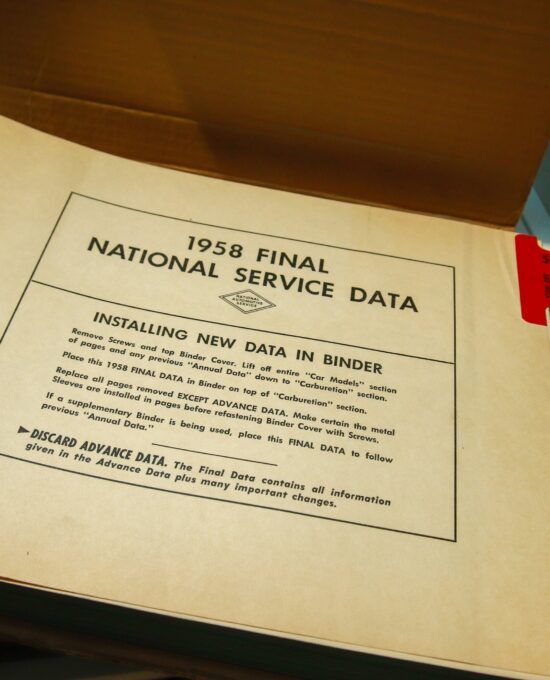
1958 “NOS” 1958 National Automotive Service Final Data In original mailing box
1958 “NOS” 1958 National Automotive Service Final Data In original mailing box
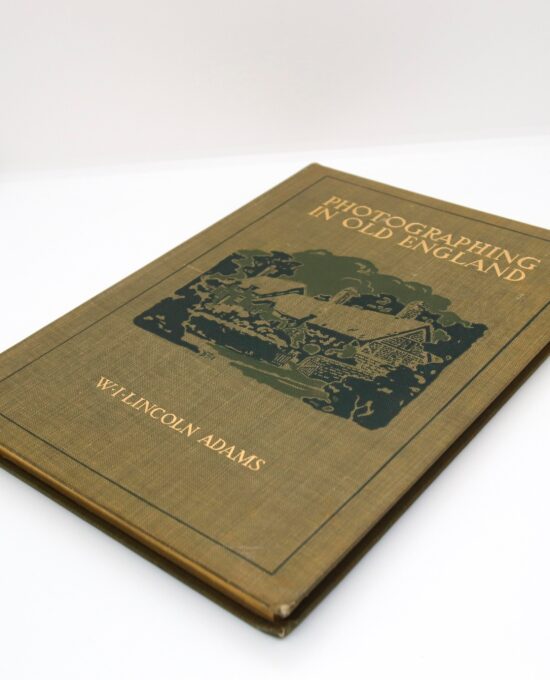
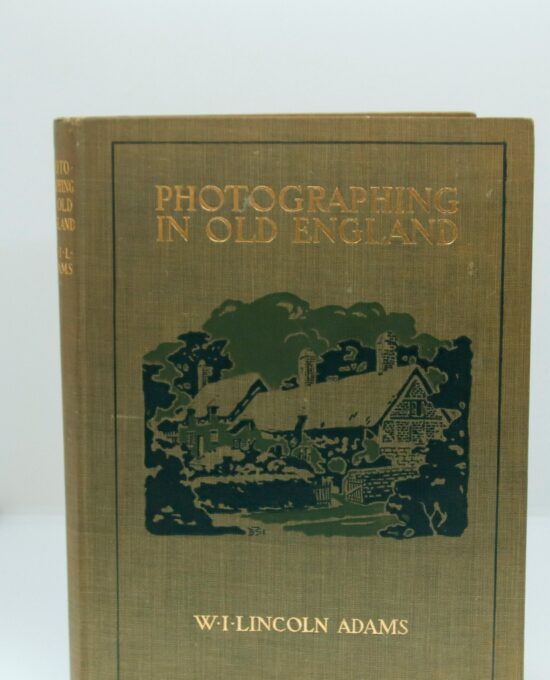
Photographing in Old England 1910 First edition Antique cloth-wrapped hardcover
Photographing in Old England 1910 First edition Antique cloth-wrapped hardcover
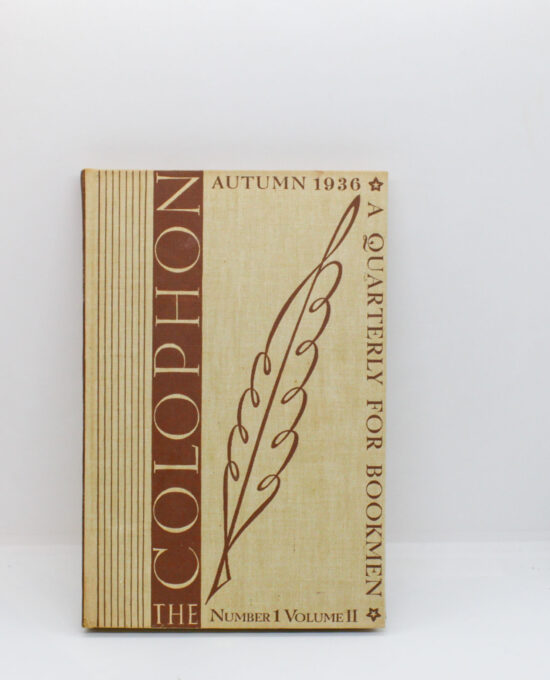

The Colophon: A Quarterly for Bookmen (Autumn 1936) Vintage hardcover
Reviews
There are no reviews yet.